Tooth movement in orthodontics (pressure and tension)
What you need to know
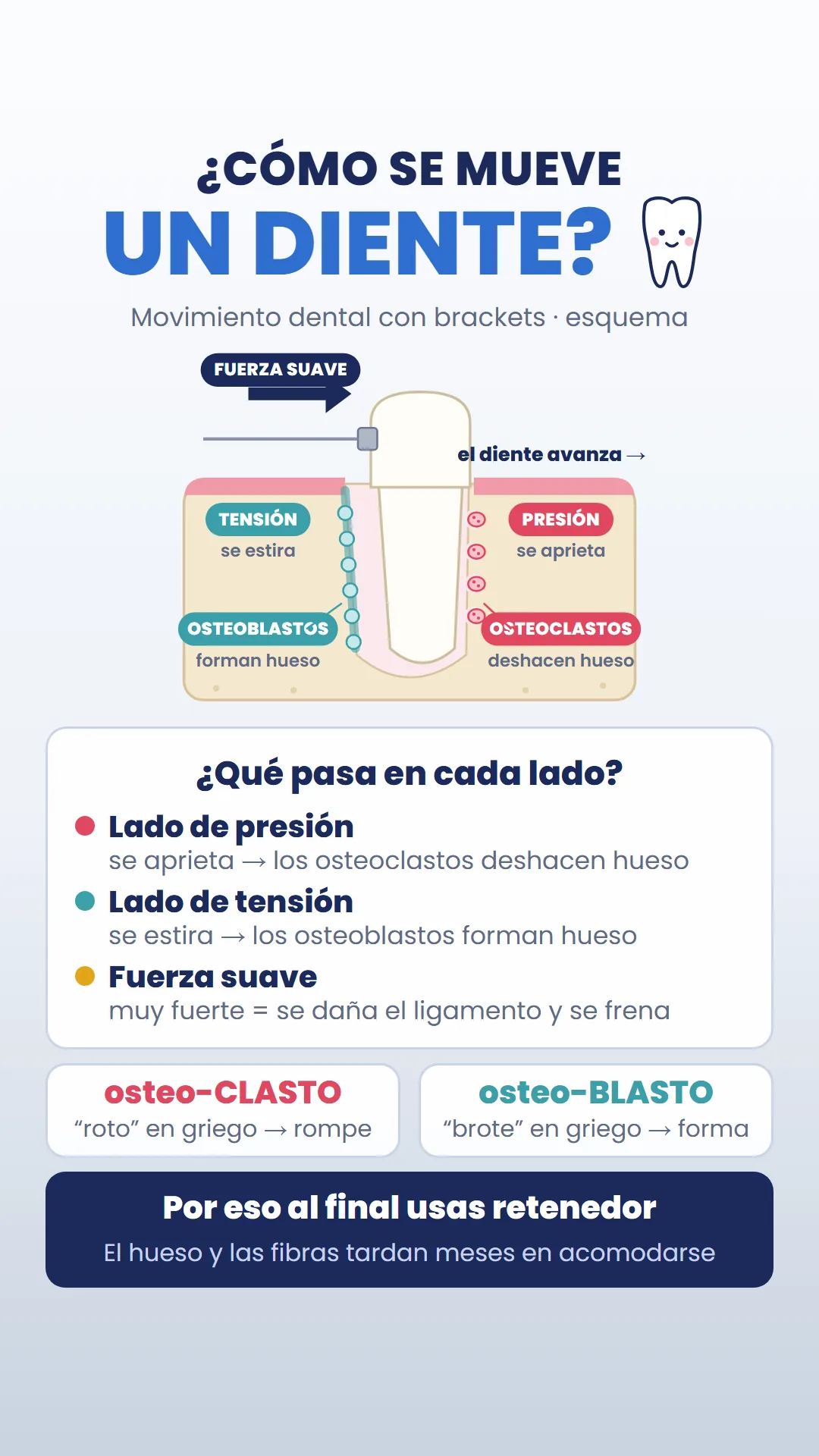
- Pressure side: the periodontal ligament is compressed and osteoclasts resorb the bone to clear the way.
- Tension side: the ligament is stretched and osteoblasts deposit new bone.
- With light, continuous forces, resorption happens directly on the pressure side.
- With excessive forces, the ligament gets crushed so much that it's left without cells (it hyalinizes). Then the bone breaks down from behind (undermining resorption) and the movement slows down.
- After treatment, the bone and fibers take months to reorganize: that's why a retainer is used.
Terms in plain words
OsteoclastCell that resorbs (breaks down) bone. “Clast” comes from the Greek word for “broken”.
OsteoblastCell that forms bone. “Blast” comes from the Greek word for “bud”.
HyalinizationArea of the ligament left without cells due to excess pressure; it delays movement.
For the exam
Which cell works on the pressure side?
Show answerHide answer
The osteoclast, which resorbs bone. On the tension side, it's the osteoblast, which forms it.
Sources
- Haworth JA, Sandy JR. Contemporary theories of orthodontic tooth movement. Orthodontic Update. 2024;17(2):56–62.
- Molecular and Biological Aspects of Orthodontic Tooth Movement: Possibilities for Bioengineering Intervention: A Narrative Review. View source
More from Orthodontics & Occlusion
Angle
Angle's classification
Angle classifies the bite by how the mesiobuccal cusp of the upper first molar fits with the buccal groove of the lower first molar.
Bites
Overjet, overbite and types of bite
Besides the Angle class, you look at how the front teeth meet: the overjet (forward) and the overbite (downward).
Canine guidance
Canine guidance and group function
In canine guidance, when you move your lower jaw to one side, only the canines touch and the back teeth separate.