Primary, secondary and tertiary dentin
What you need to know
- Primary: it forms while the tooth develops, until the root is complete. It is fast: about 4 µm per day (a micrometer, µm, is one thousandth of a millimeter).
- Secondary: it keeps forming afterward, throughout life, very slowly (about 0.4 µm per day). That is why the pulp chamber (the space that holds the pulp) gradually gets smaller with age.
- Tertiary: it forms as a defense against an injury, such as caries or wear.
- Reactionary tertiary: mild injury. It is made by the same odontoblasts that were already there, and its tubules are continuous with those of the original dentin.
- Reparative tertiary: severe injury that kills the odontoblasts. New odontoblast-like cells form dentin with few or no tubules (dentin bridge).
Terms in plain words
Dentinal tubuleTiny channel in the dentin through which the odontoblast's process runs.
Reactionary dentinTertiary dentin made by the original odontoblasts in response to a mild injury.
Reparative dentinTertiary dentin made by new cells when the odontoblasts have died.
For the exam
A carious lesion progressed quickly and the odontoblasts in that area died. Which type of dentin forms?
Show answerHide answer
Reparative tertiary dentin, made by new odontoblast-like cells.
Sources
- Farges JC, et al. Dental Pulp Defence and Repair Mechanisms in Dental Caries. Mediators Inflamm. 2015:230251. View source
- Age estimation using the pulp-to-tooth volume ratio of canines: a systematic review and meta-analysis (secondary dentin shrinks the pulp with age). View source
- Nanci A. Ten Cate's Oral Histology. Elsevier (textbook).
More from Histology & Embryology
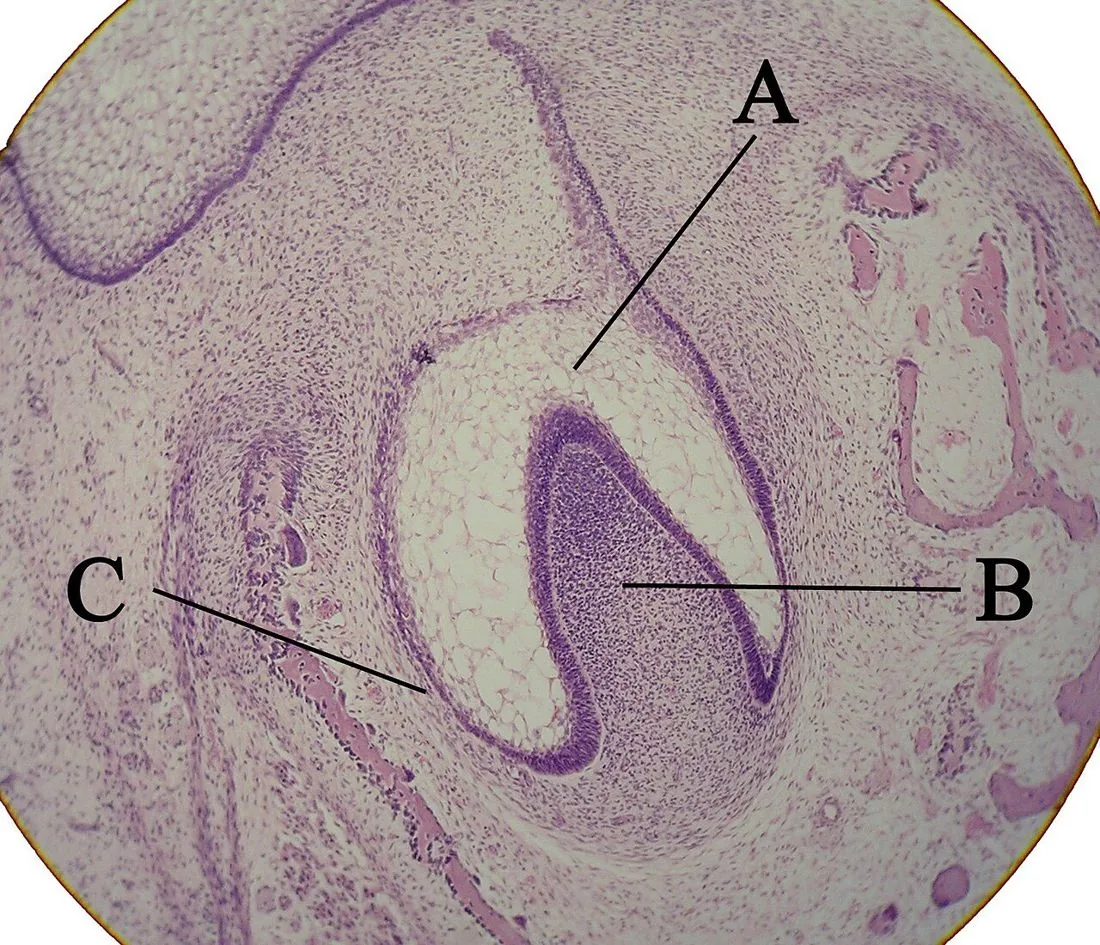
Odontogenesis
Odontogenesis: how a tooth forms
From the 6th week of intrauterine life, the tooth germ goes through 3 stages: bud, cap and bell.
Pulp
Zones of the dental pulp
From the outside in, the pulp has 4 zones: odontoblast layer, cell-free zone (of Weil), cell-rich zone and pulp core.
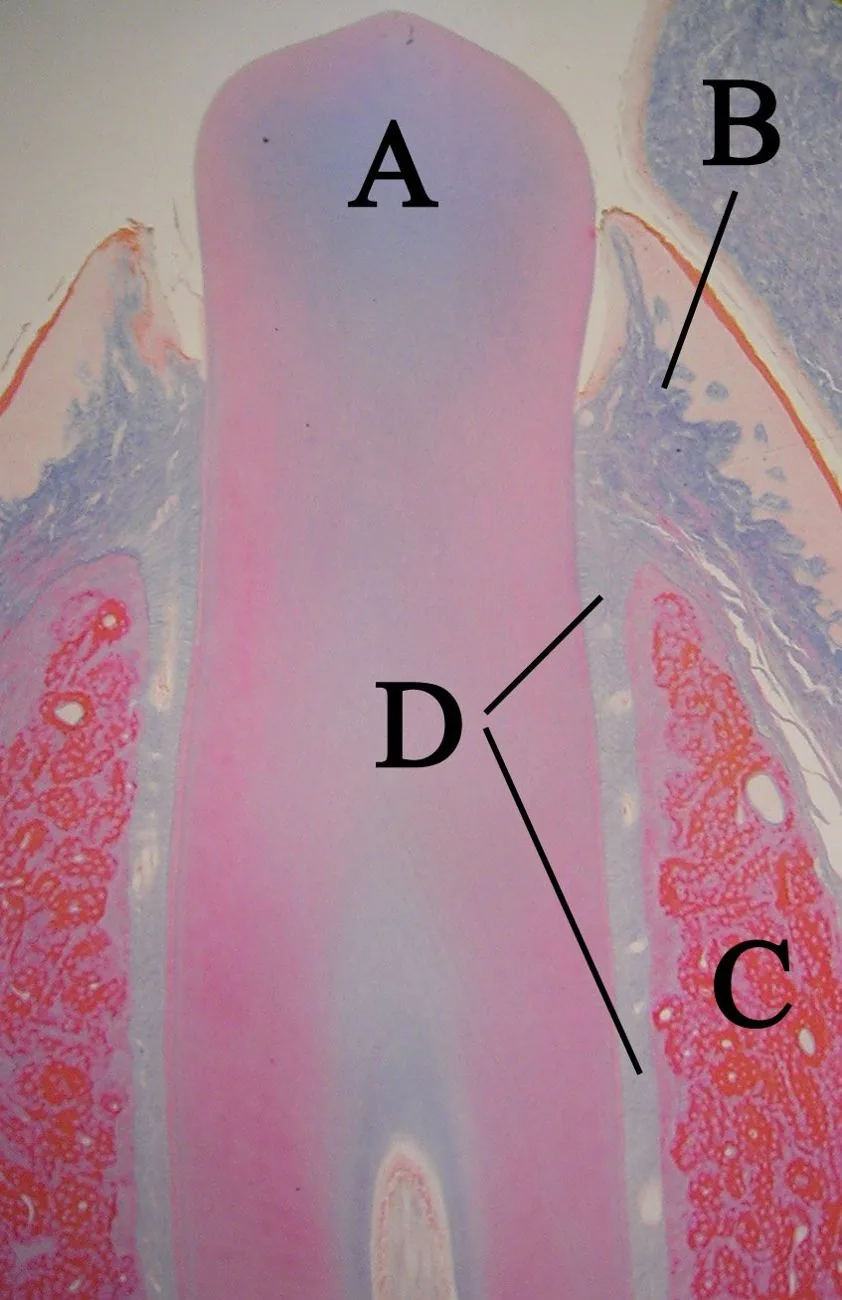
Root
Root formation: Hertwig's epithelial root sheath
The root forms thanks to Hertwig's epithelial root sheath: a double layer of epithelium that grows apically (toward where the tip of the root will end up) and defines the shape of the root.