Which nerve do you numb for each tooth?
What you need to know
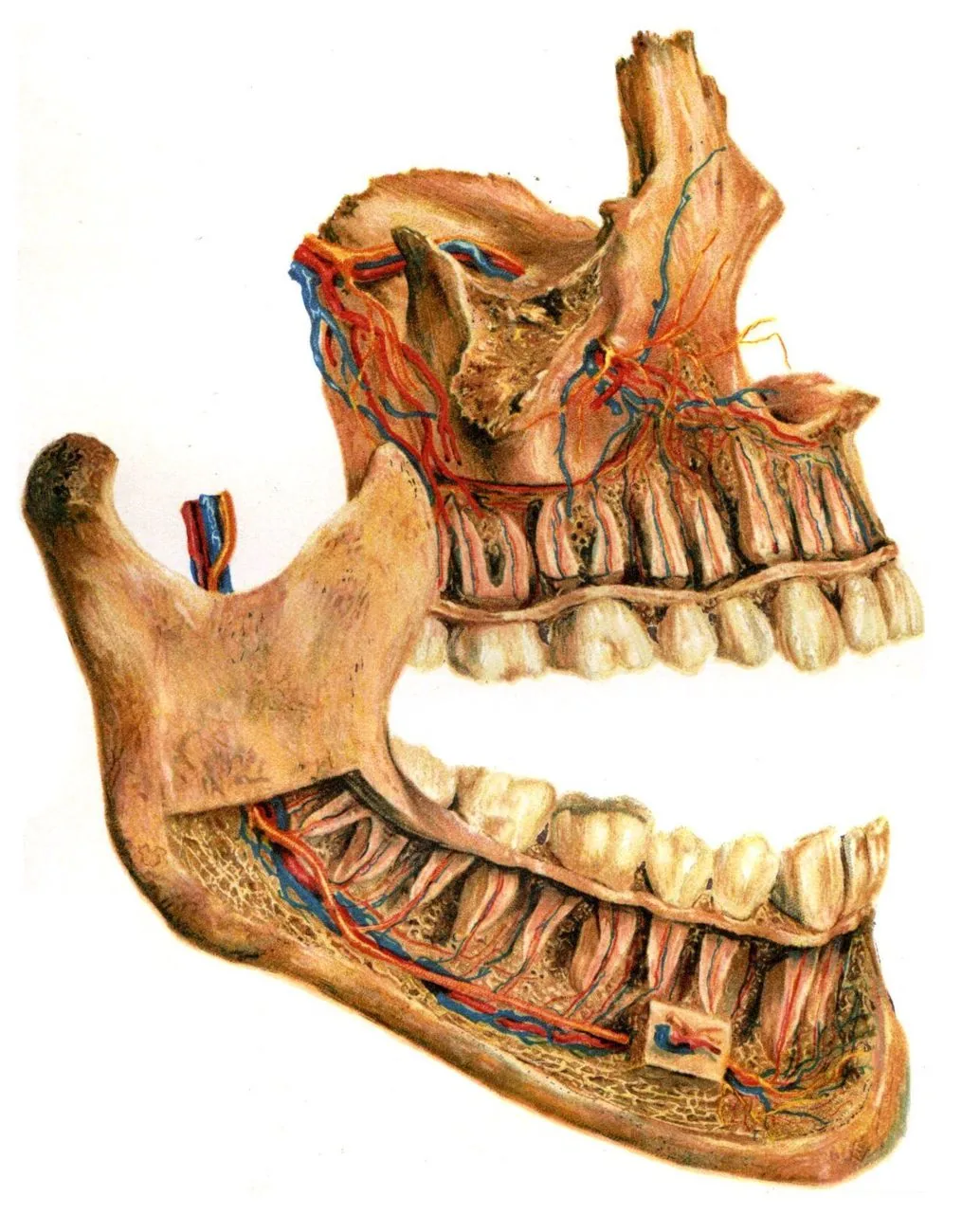
- They all come from the trigeminal nerve (the fifth cranial nerve, the one that gives sensation to the face): the upper ones branch off its maxillary division and the lower ones, off its mandibular division.
- Upper teeth: the posterior superior alveolar gives sensation to the molars; the middle one, to the premolars; and the anterior one, to the incisors and canine.
- The middle superior alveolar isn't present in everyone: in studies it shows up in about half of people. That's why the nerve supply of premolars and canines varies from one person to another.
- When anesthesia of the posterior one doesn't numb the upper first molar well, this has been explained by the fact that its mesiobuccal root (the front, outer one) can receive branches from the middle one.
- Palate: the greater palatine numbs the mucosa of the back of the palate, up to the first premolar; the nasopalatine numbs the front part, behind the incisors.
- Lower teeth: the inferior alveolar enters the mandible through the mandibular foramen and gives sensation to all the lower teeth on that side. Its branch, the mental nerve, exits through the mental foramen (below the premolars) to supply the lip and chin.
- The lingual (the tongue) and the long buccal (the outer gum of the lower molars) don't run inside the bone with the teeth: the long buccal often needs its own injection.
- Why is it enough to infiltrate on the upper teeth, while on the lower ones you do a block? The upper bone is thinner and more porous, and the anesthetic passes through it. The mandible's cortical bone (the hard outer layer) is thicker and denser: that's why you numb the nerve before it enters the bone.
- In children the mandible is less dense, and infiltration can work for baby molars.
Which nerve to numb for each area
| Area | Nerve |
|---|---|
| Upper molars | Posterior superior alveolar |
| Upper premolars | Middle superior alveolar (if present) |
| Upper incisors and canine | Anterior superior alveolar |
| Back of the palate (up to the 1st premolar) | Greater palatine |
| Front of the palate | Nasopalatine |
| All the lower teeth on one side | Inferior alveolar |
| Lower lip and chin | Mental |
| Front 2/3 of the tongue | Lingual |
| Outer gum of the lower molars (and 2nd premolar) | Long buccal |
Terms in plain words
TrigeminalThe fifth cranial nerve: it gives sensation to the face, teeth and mouth.
InfiltrationInjecting the anesthetic next to the root so it passes through the bone; it works well on the upper teeth.
BlockInjecting near the trunk of a nerve to numb everything that nerve innervates.
Cortical boneThe hard, compact outer layer of bone.
For the exam
Why is infiltration enough for an upper molar, while a lower molar needs a block?
Show answerHide answer
Because the mandible's cortical bone is thicker and denser: the anesthetic doesn't pass through it well, so you numb the inferior alveolar nerve before it enters the bone.
Sources
- Hino K, et al. Innervation of the Maxillary Teeth: Integrating Classical Anatomy With the Dual Innervation Model. Clin Anat. 2026;39(6):705–714. View source
- Iwanaga J, Tubbs RS. Palatal Injection does not Block the Superior Alveolar Nerve Trunks. Cureus. 2018;10(1):e2120. View source
- Powers DB. How To Do an Inferior Alveolar Nerve Block. MSD Manual, Professional Version (2025 revision). View source
- Badr N, Aps J. Efficacy of dental local anesthetics: A review. J Dent Anesth Pain Med. 2018;18(6):319–332. View source
- American Academy of Pediatric Dentistry (AAPD). Use of Local Anesthesia for Pediatric Dental Patients. Reference Manual of Pediatric Dentistry, 2025:407–14. View source
More from Anesthesia
Anesthetics
How local anesthesia works
Local anesthesia switches off the nerve signal for a while: the pain doesn't reach the brain, but the person stays awake.
Anesthesia
Inferior alveolar nerve block
It numbs the lower teeth on that side, the lip and chin, and almost always the tongue too.
Safety
Safe anesthesia: aspiration, dosage and complications
Before injecting, you aspirate so you don't put the anesthetic into a blood vessel, you inject slowly, and you never go over the maximum dose based on weight.